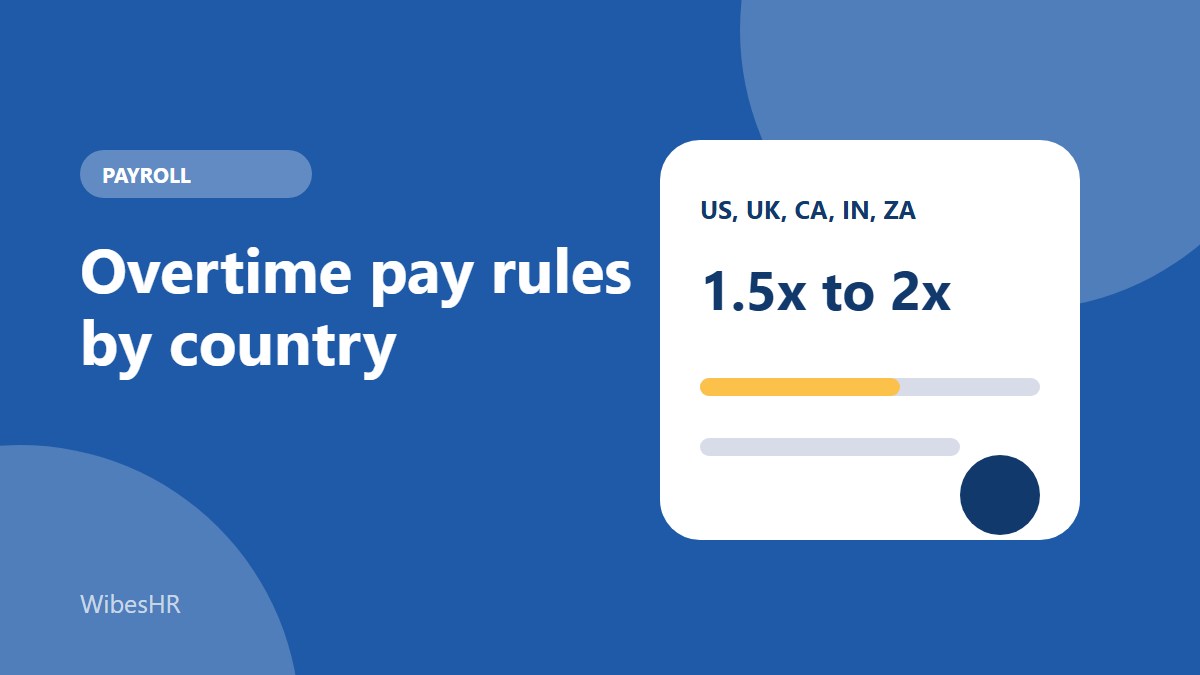
Overtime is the part of payroll where one wrong assumption costs real money. The same 46-hour week is paid very differently in Texas, California, Ontario, Mumbai and Johannesburg. This guide puts the rules for the United States, United Kingdom, Canada, India and South Africa side by side, shows the formula, and works through one example per country.
Note: overtime law changes by state, province and sector, and collective agreements can be better than the law. Treat this as a working guide and confirm the final rule with your accountant or labour adviser before you change a payroll.
What overtime means and when it starts
Overtime is pay for hours worked beyond a set limit. Two things decide it: the threshold (when extra hours start counting) and the multiplier (how much more each extra hour pays). Some countries set the threshold per day, some per week, and some leave it to the contract.
Three terms come up in every country:
- Threshold: for example 40 hours a week, or 8 hours a day.
- Multiplier: 1.5x means time and a half, 2x means double time.
- Regular (ordinary) rate: the hourly rate the multiplier is applied to. This is where most mistakes happen, because it is not always the basic salary alone.
Overtime rules by country at a glance
| Country | When it starts | Standard rate | Rest day / holiday |
|---|---|---|---|
| United States (federal, FLSA) | Over 40 hours in a workweek (non-exempt staff) | 1.5x regular rate | No federal premium; some states add daily or seventh-day rules |
| United Kingdom | Set by the contract | No statutory premium | Contract decides; minimum wage must still be met |
| Canada | Province decides, for example 44 hours a week in Ontario, 40 federally | 1.5x in most places | Public holiday rules differ by province |
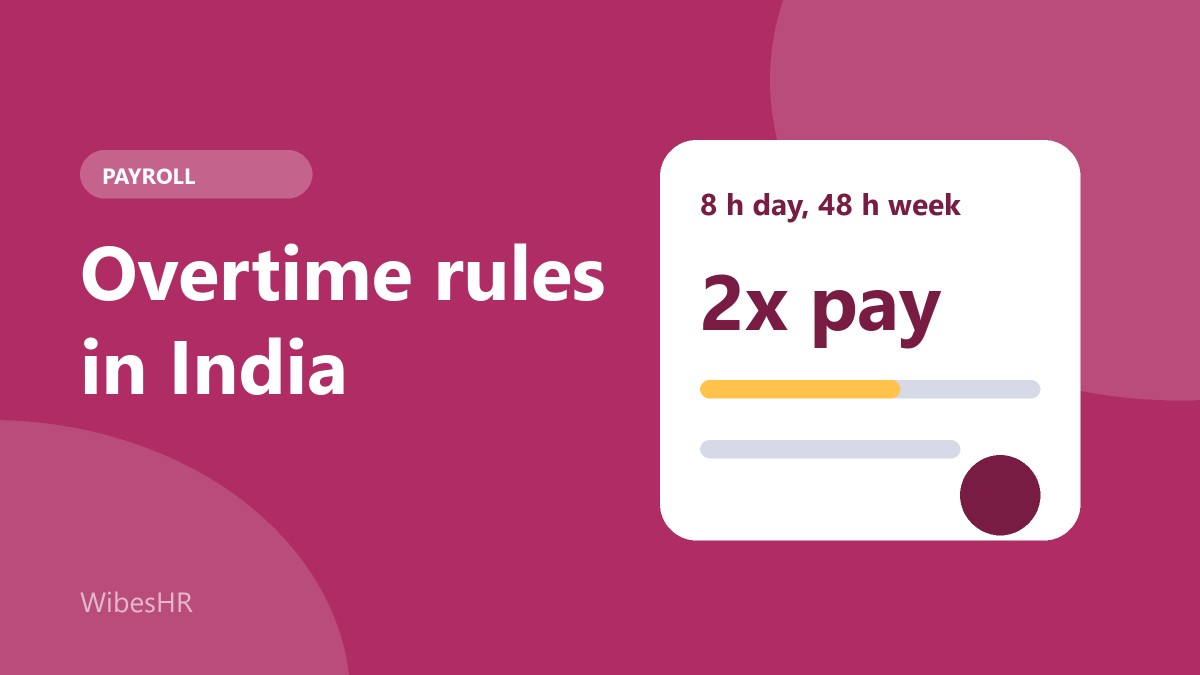
| India | Beyond daily or weekly limits (Factories Act: 9 hours a day, 48 a week) | 2x ordinary rate of wages | Weekly off work is treated under the same law or state rules |
| South Africa (BCEA) | Hours beyond the ordinary working hours | 1.5x wage | 2x on Sundays (unless Sunday is a normal workday) and public holidays |
United States: 1.5x over 40, and state rules on top
Under the federal Fair Labor Standards Act, non-exempt employees must be paid at least 1.5 times their regular rate for every hour over 40 in a workweek. There is no federal daily overtime rule. Exempt employees (certain salaried executives, administrative and professional staff) are not covered, but exemption depends on duties and salary level, not on a job title.
Several states go further. California, for example, requires 1.5x after 8 hours in a day, and 2x after 12 hours in a day. Always apply the rule that is more favourable to the employee.
The regular rate is not just the hourly wage. Non-discretionary bonuses (such as an attendance or production bonus) must be added to the week's pay before the rate is worked out. Many employers miss this.
United Kingdom: the contract decides
UK law does not give a general right to higher pay for overtime. The rate is whatever the employment contract, policy or agreement says. Two rules still apply: the Working Time Regulations limit the average week to 48 hours unless the worker opts out in writing, and pay must never fall below the National Minimum Wage or National Living Wage once overtime hours are averaged in.
Holiday pay is a frequent issue. Where overtime is regular or compulsory, it usually has to be reflected in holiday pay, so check how your payroll calculates it.
Canada: the province sets the rule
There is no single Canadian overtime rule. Each province and territory has its own, and federally regulated employers follow the Canada Labour Code. Typical examples:
- Ontario: 1.5x after 44 hours a week.
- British Columbia: daily overtime after 8 hours, double time after 12, and weekly overtime after 40.
- Federal: 1.5x after 8 hours a day or 40 hours a week.
Some provinces also allow "time off in lieu" of pay under written agreement, and managers or certain professions are often excluded.
India: double the ordinary rate
For factories, the Factories Act requires overtime to be paid at twice the ordinary rate of wages, and sets limits on daily and weekly hours. Most state Shops and Establishments Acts follow a similar double-rate principle, but details and caps differ by state. India's new labour codes (the Occupational Safety, Health and Working Conditions Code in particular) also keep the double rate, so check the current state rules and your company policy.
The "ordinary rate of wages" normally includes basic pay, dearness allowance and certain allowances, but not bonus or overtime itself. Many Indian employers divide monthly wages by 26 days and 8 hours, but the correct divisor depends on your policy and the state rule, so write down the method you use.
South Africa: 1.5x, with limits
The Basic Conditions of Employment Act (BCEA) limits overtime to an agreed amount, no more than 3 hours a day or 10 hours a week, and requires pay of at least 1.5 times the normal wage. Sunday work is paid at double the normal wage, unless the employee ordinarily works Sundays, in which case it is 1.5x. Public holidays are also paid at double. An agreement can allow paid time off instead of overtime pay.
The BCEA overtime rules apply only to employees below an earnings threshold that the Minister of Employment and Labour updates each year, so confirm the current figure before treating a senior employee as excluded.
How to calculate overtime pay
The method is the same everywhere:
- Find the employee's hourly rate.
- Count the overtime hours using the threshold for that country, state or contract.
- Multiply: overtime pay = overtime hours x hourly rate x multiplier.
For a monthly salary, the usual hourly rate is: annual salary / (52 weeks x weekly hours). In South Africa the BCEA monthly equivalent is weekly hours x 52 / 12.
Worked examples
United States: 46 hours with a bonus
A non-exempt employee earns $20 an hour, works 46 hours, and receives a $50 non-discretionary bonus. Straight-time pay is 46 x $20 = $920. Add the bonus: $970. The regular rate is $970 / 46 = $21.09. The extra half-time premium on the 6 overtime hours is 6 x 0.5 x $21.09 = $63.26. Total pay for the week is $1,033.26.
California: a 14-hour day at $25
8 hours at $25 = $200. The next 4 hours at 1.5x = 4 x $37.50 = $150. The last 2 hours at 2x = 2 x $50 = $100. Total for the day: $450.
United Kingdom: contract overtime at 1.5x
Salary £30,000, 37.5-hour week. Hourly rate = £30,000 / (52 x 37.5) = £15.38. At a contractual 1.5x, overtime is £23.08 an hour, so 5 hours is £115.38.
Ontario, Canada: 48 hours at $22
The first 44 hours: 44 x $22 = $968. The 4 extra hours at 1.5x: 4 x $33 = $132. Total: $1,100.
India: 10 overtime hours
Monthly basic plus dearness allowance is ₹30,000. Using 26 days x 8 hours = 208 hours, the ordinary hourly rate is ₹144.23. Double rate = ₹288.46. For 10 overtime hours the pay is ₹2,884.62.
South Africa: 4 overtime hours, and a Sunday
Monthly wage R12,000 on a 45-hour week. Monthly hours = 45 x 52 / 12 = 195. Hourly rate = R61.54. At 1.5x the overtime rate is R92.31, so 4 hours is R369.23. A Sunday hour at 2x is R123.08.
Common overtime mistakes
- Wrong base rate. Leaving out allowances or non-discretionary bonuses from the rate.
- Treating a salary as an exemption. In the US, a salaried employee can still be non-exempt.
- Ignoring state or provincial rules. The federal or national rule is only the floor.
- Unapproved hours. Paying whatever the timesheet says, or refusing to pay hours the manager knew about, both create risk.
- Rounding. Rounding every punch down quietly underpays the team. Use a consistent, documented rounding rule.
- Night shifts and rotating rosters. A shift that crosses midnight or a rest day needs a clear rule on which day the hours belong to.
How to run overtime cleanly in payroll
A reliable overtime process has four parts: attendance that records actual hours, a written policy for the threshold and multiplier, a manager approval step so only approved hours are paid, and payroll that shows hours and rate on the payslip. When these live in one system, you avoid re-typing hours into spreadsheets, and the numbers can be audited later.
WibesHR keeps attendance, shifts, leave and payroll in one place for companies in India, South Africa, the UK, the US and Canada, so the hours that managers see are the hours payroll uses.
Frequently asked questions
Is overtime always paid at 1.5x?
No. Time and a half is the common rate in the US, Canada and South Africa, but India uses double, the UK has no statutory rate, and many countries add 2x for rest days, public holidays or long daily hours.
Do salaried employees get overtime?
It depends on the country and the role. In the US, salaried employees can be non-exempt and still entitled to overtime. In South Africa, employees above the earnings threshold are excluded from the BCEA overtime rules. Check the job duties and pay level, not just the word salaried.
How do I calculate the hourly rate from a monthly salary?
Divide the annual salary by 52 weeks and then by the weekly working hours. In India many employers use monthly wages divided by 26 days and 8 hours. Whatever method you choose, document it and apply it to everyone the same way.
Can I give time off instead of overtime pay?
Sometimes. South Africa and several Canadian provinces allow time off in lieu with a written agreement, usually at the same multiplier. The US generally does not allow it for private-sector employers.
Does overtime count towards the minimum wage?
In the UK, the minimum wage test looks at pay averaged over the pay reference period, so unpaid or underpaid extra hours can cause a breach. Always check this when staff regularly work beyond their contract hours.