When an employee leaves, the last payslip is only part of the work. HR also has to settle everything the company owes the person, and everything the person owes the company: the final month's salary, leave encashment, gratuity, bonus, notice pay, loans and assets. That settlement is called full and final settlement, or F&F. Done late or wrongly, it is one of the most common reasons an ex-employee files a complaint.
This guide explains how full and final settlement works in India in 2026: what the law says about timing, what to include, a worked calculation, how gratuity and leave encashment are taxed, a simple settlement format, and the mistakes to avoid. It was last checked against official government sources on 2 November 2026. It is guidance for HR and finance teams, not legal advice, so confirm the details for your company and your state with your accountant or counsel.
What full and final settlement means
"Full and final settlement" is not a single defined term in the labour codes. It is the practice of working out, in one statement, everything due on separation and paying it. It applies whether the person resigns, is terminated, retires or is retrenched, and the dues are mostly governed by separate rules, which is why the timelines differ.
What the law says about timing
| Due | Rule |
|---|---|
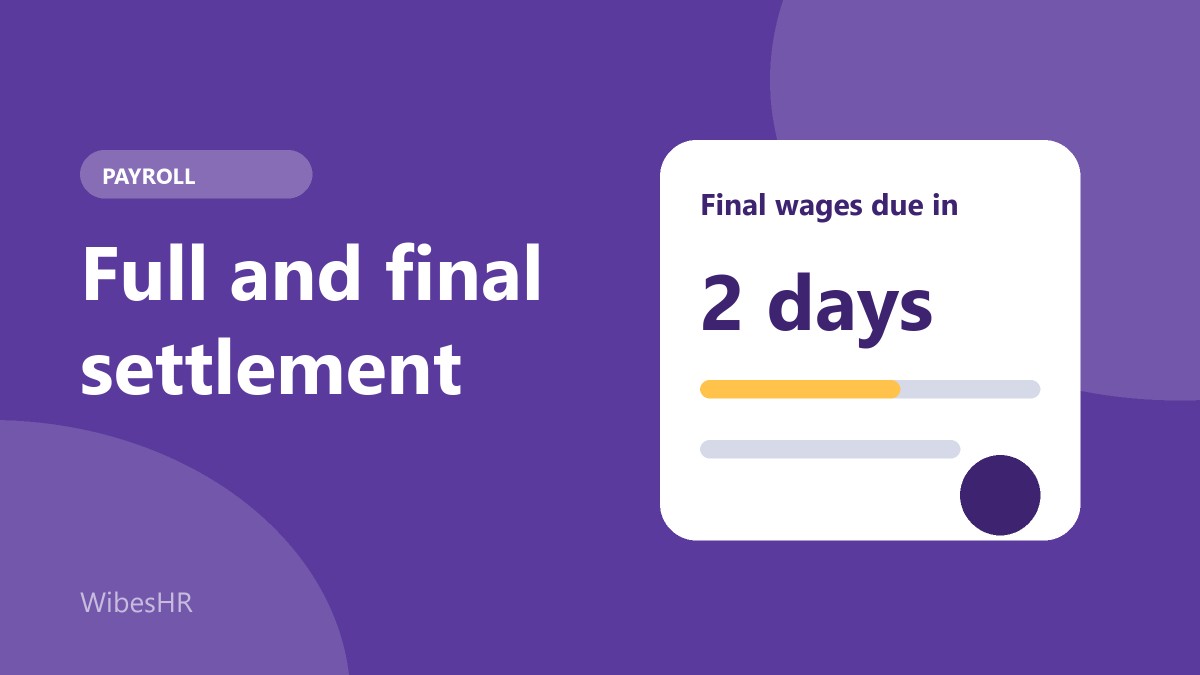
| Wages earned up to the last day | Under section 17(2) of the Code on Wages, wages must be paid within two working days of removal, dismissal, retrenchment or resignation. The appropriate government can set a different period |
| Gratuity | Under the Code on Social Security, 2020, gratuity must be paid within 30 days of becoming payable, with simple interest on delay |
| Retrenchment compensation | Under the Industrial Relations Code, a worker with at least a year of service gets one month's written notice or pay in lieu, and 15 days' average pay for each completed year of service (a part above six months counts as a year). Employers must also pay 15 days' wages per retrenched worker into the Workers' Re-Skilling Fund |
| Other dues (leave encashment, bonus, reimbursements) | Follow the law and your written policy. We found no single statutory deadline for the whole F&F statement, and many companies promise 30 to 45 days in policy. Paying sooner is safer |
The key point is that the two-working-day rule covers wages. If your policy says F&F is paid after 45 days, make sure at least the final salary is paid within two working days, and check how your state applies the rule.
What goes into the settlement
Amounts the employee receives
- Salary up to the last working day, pro rata for a part month
- Leave encashment for the earned leave balance, as per your leave policy and the law
- Gratuity, if the employee is eligible (normally after five years of continuous service)
- Bonus or incentive earned up to the date of exit, as per the bonus law and your policy
- Pending reimbursements and expense claims
- Notice pay, if the company waives the notice period or asks the employee not to serve it
- Retrenchment compensation, if the person is retrenched
Amounts recovered from the employee
- Shortfall in the notice period, if your contract provides for recovery
- Outstanding loans or salary advances
- Value of company assets not returned, supported by an asset record
- Statutory deductions on the pay: provident fund, ESI where applicable, professional tax and income tax (TDS)
The Code on Wages limits total deductions from wages in a wage period to 50% of those wages, so a large recovery may have to be spread out. Recover only what the contract or a signed document allows, and record the basis of every deduction.
A worked example
An employee resigns and her last working day is the 20th of a 30-day month. Her monthly gross is ₹60,000, of which basic pay and dearness allowance are ₹30,000 (wages for gratuity). She joined 6 years and 4 months ago, has 12 days of earned leave, owes ₹10,000 on a loan, and is short of 15 days on a notice period.
| Item | Calculation | Amount |
|---|---|---|
| Salary for 20 days | ₹60,000 x 20 / 30 | ₹40,000.00 |
| Leave encashment | 12 days x ₹30,000 / 26 (example policy: basic pay over 26 days) | ₹13,846.15 |
| Gratuity | ₹30,000 x 15 / 26 x 6 completed years | ₹103,846.15 |
| Total payable | ₹157,692.31 | |
| Less: notice shortfall | ₹30,000 / 30 x 15 days | ₹15,000.00 |
| Less: loan outstanding | ₹10,000.00 | |
| Net before statutory deductions | ₹132,692.31 |
Provident fund, professional tax and TDS on the salary part come off as in any normal payslip. The leave encashment basis (26 days, 30 days, basic or gross) comes from your policy, not from the law, so use the same one for everyone. The gratuity formula is 15 days' wages for each completed year, with a part year above six months counting as a full year.
How gratuity and leave encashment are taxed
Gratuity
For an employee covered by the Payment of Gratuity rules, the tax-exempt amount is the least of: 15/26 of last drawn salary for each completed year of service (or part above six months), ₹20 lakh, and the gratuity actually received. Anything above the least of these is taxable as salary.
Leave encashment
For a non-government employee, encashment on retirement or resignation is exempt up to the least of: the amount received, the unused leave multiplied by average monthly salary, 10 months' average salary, and ₹25 lakh. Unused earned leave counts up to 30 days for each year of service with the current employer, and the limit is reduced by any exemption claimed earlier. Leave encashed while still in service is fully taxable.
These figures come from the Income Tax Department's published guidance, which refers to the older Income-tax Act. The new Income-tax Act, 2025 applies from April 2026 with renumbered sections, so check the current section numbers and limits with your tax adviser. Whatever is taxable goes into the employee's TDS for the year and into their Form 16.
Fixed-term employees and the new labour codes
The labour codes came into force on 21 November 2025. Fixed-term employees are entitled to gratuity after one year of continuous service, paid pro rata when the contract ends, without the usual five-year condition. The new definition of wages, which can add back allowances that are more than 50% of total pay, applies to gratuity from that date. Our guide to the new labour codes and payroll explains the wage rule with an example.
A simple full and final settlement format
Use one statement for every exit, with the same fields, signed by both sides. A clear layout is:
- Employee name, code, designation, department, joining date, last working day, reason for exit
- Notice period required, served and short or waived
- Earnings: salary for the days worked, leave encashment (days and rate), gratuity (years and wage), bonus, reimbursements, any notice pay or other amount, with a basis for each
- Recoveries: notice shortfall, loan or advance, assets not returned, with the basis for each
- Statutory deductions: PF, ESI, professional tax and TDS
- Net payable, payment date, bank account and payment reference
- A statement that the dues listed are accepted as full and final, the employee's acknowledgement and signature, and the signature of an authorised HR and finance person
A step-by-step exit process
- Record the resignation or termination date and the notice period agreed
- Get leave, attendance and expense records closed up to the last day
- Collect assets and get clearance from IT, admin, finance and the manager
- Work out the settlement and get it reviewed by a second person
- Pay the final wages within two working days, and the rest within your policy period, with gratuity within 30 days if due
- Give the settlement statement, relieving letter, experience letter and the details for the Form 16 and provident fund transfer
- Update the date of exit with the provident fund and ESI, so the employee can move or claim the account without trouble
The mistakes employers make
- Holding back all dues until clearance is done, including the final wages that the law requires within two working days
- Recovering more than the contract allows, or more than 50% of wages in one go, without a signed basis
- Calculating gratuity on basic pay only, after the wage definition has changed
- Forgetting fixed-term employees and part-year service when working out gratuity
- Treating leave encashment and gratuity as fully taxable, or as fully exempt, without applying the limits
- No signed statement, so there is no record that the person accepted the figures
- Not updating the exit date with PF and ESI
How WibesHR helps
The WibesHR HR and payroll module keeps the records an F&F relies on in one place. Attendance, leave balances and approved leave are available for the last month, loans show what is outstanding and can be pre-closed, and a leaver in the middle of a month is paid only for the days they were employed, with the payslip showing the days not employed. The payslip and PDF can be sent to the employee, and the provident fund and ESI figures follow the India payroll pack. For overtime and approved allowances, the pay run takes what has been approved up to the exit date.
To be clear about the limits: WibesHR does not yet calculate gratuity, leave encashment or the tax exemption on them, and it does not produce a full and final settlement statement, so use a worksheet like the one above for those and enter any final amounts as pay heads where you need them on the payslip. It does not file anything with EPFO or ESIC. Plans are priced per employee per month, and the 7-day free trial includes every feature and needs no payment details. For the PF and ESI side of an exit, see our guide to PF and ESI.
Leave balances feed leave encashment, so see also our guide to leave and attendance management software.
Frequently asked questions
Within how many days must full and final settlement be paid in India?
The Code on Wages requires wages to be paid within two working days of removal, dismissal, retrenchment or resignation, and gratuity within 30 days of becoming payable. We found no single statutory deadline for the full F&F statement, so companies set one in policy, often 30 to 45 days. Paying earlier is safer.
Is gratuity part of full and final settlement?
Yes, if the employee is eligible. It is normally payable after five years of continuous service, and for fixed-term employees after one year, pro rata, when the contract ends.
Is leave encashment taxable?
On retirement or resignation, a non-government employee gets an exemption up to the least of four amounts, with a cap of ₹25 lakh. Leave encashed during service is fully taxable. Check the current limits and section numbers with your tax adviser.
Can the company deduct notice pay from the final settlement?
Only if the employment contract or policy provides for it, and total deductions in a wage period are limited to 50% of wages under the Code on Wages. Record the basis for the recovery and get it signed.
What documents should the employee receive?
The signed settlement statement, a relieving letter, an experience letter, the payslip for the last month, and the Form 16 details. The employee also needs the provident fund exit date updated.
Is this legal advice?
No. The rules are changing and the final rules under the labour codes are still being notified. Use this guide to understand the process and check the details with the Ministry of Labour and Employment, your state rules and your adviser.