Provident fund (PF) and Employees' State Insurance (ESI) are the two deductions that every Indian payroll team gets asked about, and the two that most often go wrong. The rates look simple, but the details around them (which wage counts, which ceiling applies, who is covered, when to pay) have changed twice in the last year. The labour codes came into force on 21 November 2025, and on 17 September 2026 the EPF wage ceiling went up from ₹15,000 to ₹25,000.
This guide explains how PF and ESI work for an employer in 2026: the rates, the wage limits, who must register and when, a worked calculation for each, the due dates, and the mistakes that cost the most. It was last checked against official EPFO, ESIC and PIB sources on 2 November 2026. It is guidance for HR and finance teams, not legal advice, so confirm the details for your company with your accountant.
The law behind them now
- The Code on Social Security, 2020 came into force on 21 November 2025 and now governs both schemes. ESIC's circulars say the older ESI Act is replaced, and the new definition of wages applies from that date
- PF applies to every establishment with 20 or more employees, in any industry. Smaller establishments can join voluntarily if the employer and employees agree
- ESI applies to every establishment with 10 or more persons, other than a seasonal factory. Work in hazardous occupations can be covered even for a single worker, and smaller establishments can join voluntarily
- The ₹21,000 ESI wage limit continues until the rules under the code are finalised
Provident fund: rates and limits
| Item | Rate or limit | Who pays |
|---|---|---|
| Employee contribution | 12% of PF wages, all to the EPF account | Employee |
| Employer contribution | 12%, of which 8.33% goes to the pension scheme (EPS) and 3.67% to EPF | Employer |
| EDLI (insurance) | 0.5% of wages | Employer only |
| Administrative charge | 0.5% of wages, with a minimum of ₹500 a month for the establishment | Employer |
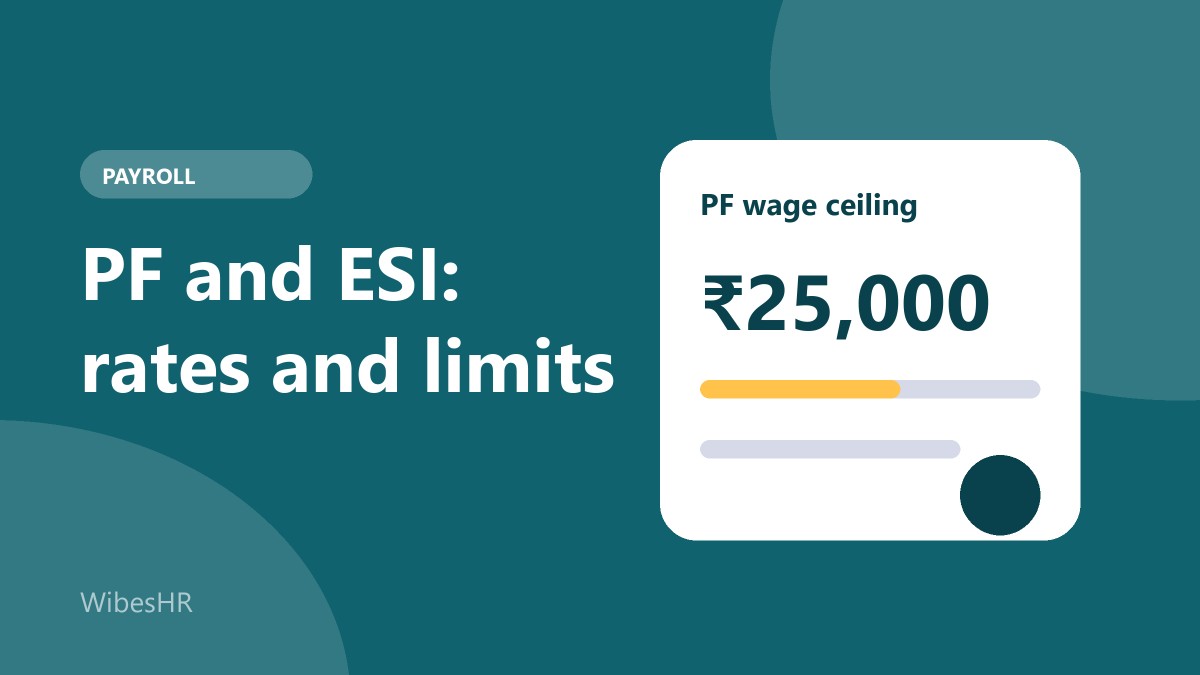
| Wage ceiling | ₹25,000 a month from 17 September 2026 (₹15,000 before) | - |
| Maximum EPS contribution | ₹2,083 a month at the new ceiling (₹1,250 before) | Employer |
Which wage counts
PF is calculated on basic pay, dearness allowance and retaining allowance. Since 21 November 2025 the wage definition in the labour codes also adds back allowances that exceed 50% of total remuneration, which can raise your PF wage. We explain this in detail in our guide to the new labour codes and payroll.
The mandatory contribution is capped at the ceiling. An employer and employee can agree to contribute on the full wage above the ceiling, but the pension (EPS) part stays limited to the ceiling, and the administrative charge is worked out on the statutory wage only.
The ₹25,000 ceiling: what changes
- Employees who earn between ₹15,000 and ₹25,000 become eligible for mandatory EPF, EPS and EDLI cover. The government estimates that more than 51 lakh workers are newly covered
- EPFO's regional offices have told employers to enrol the newly eligible workers, file the electronic return (ECR) on time and keep Aadhaar and KYC details linked
- September 2026 needs care, because the old ceiling applies to the days before 17 September and the new ceiling to the days after
A worked PF example
An employee has PF wages of ₹40,000 a month (the figure from our labour-code example). The mandatory contribution is capped at the ceiling of ₹25,000.
| Line | Calculation | Amount |
|---|---|---|
| Employee PF | 12% of ₹25,000 | ₹3,000 |
| Employer pension (EPS) | 8.33% of ₹25,000 | ₹2,083 |
| Employer EPF | 12% of ₹25,000 less EPS | ₹917 |
| EDLI | 0.5% of ₹25,000 | ₹125 |
| Administrative charge | 0.5% of ₹25,000 | ₹125 |
| Employer cost for PF | ₹3,000 + ₹125 + ₹125 | ₹3,250 |
Amounts are rounded to the nearest rupee. If the employer and employee agree to contribute on the full ₹40,000, the employee's 12% would be ₹4,800 and the employer can match it, while the EPS part and the administrative charge stay on ₹25,000.
ESI: rates and limits
| Item | Rate or limit |
|---|---|
| Employee contribution | 0.75% of wages |
| Employer contribution | 3.25% of wages (4% in total) |
| Coverage limit | ₹21,000 a month, and ₹25,000 for a person with disability |
| Very low daily wage | No employee share at ₹176 a day or less, the employer still pays its share |
| Contribution periods | 1 April to 30 September, and 1 October to 31 March |
How coverage works
- An employee is covered when monthly wages are at or below the limit
- If wages cross the limit after a contribution period has started, the employee stays covered until that period ends, and contributions continue on the full wages
- Overtime is left out when testing the limit, but ESIC's FAQ includes it when working out the contribution, and says there is no ceiling on the wages used for contributions
- If a pay rise is backdated past the limit, coverage is affected only after the contribution period in which the increase was announced ends
A worked ESI example
| Case | Wages | Employee 0.75% | Employer 3.25% |
|---|---|---|---|
| Regular pay, within the limit | ₹18,000 | ₹135 | ₹585 |
| ₹20,000 pay plus ₹2,500 overtime (covered, since the test excludes overtime) | ₹22,500 | about ₹169 | about ₹731 |
| ₹23,000 pay in a month after the employee was already covered in the same period | ₹23,000 | ₹172.50 | ₹747.50 |
Round each contribution according to ESIC's current rules, and check the amount against the challan the portal produces.
Registration
- PF: register the establishment with EPFO through its employer portal once the 20-employee threshold is met (or voluntarily). Each employee gets a Universal Account Number (UAN), which stays with them across jobs
- ESI: the employer must register within 15 days of the date the Act becomes applicable, as ESIC's FAQ states. You then get an employer code, and each insured person gets an insurance number
- Collect UAN, ESI number, Aadhaar and bank details at joining, and record the date of joining and any previous PF membership. A missing or wrong UAN can cause an ECR to be rejected
Due dates
| What | When |
|---|---|
| PF contribution and ECR for the month | On or before the 15th of the next month. EPFO withdrew the 5-day grace period from February 2016 |
| ESI contribution for the month | Within 15 days of the end of the month in which the wages fall due |
Dates can move when they fall on a holiday, and procedures are updated from time to time, so confirm on the EPFO and ESIC portals before you pay.
A monthly PF and ESI checklist
- Confirm each new joiner has a UAN and, if eligible, an ESI number before the first pay run
- Review which employees cross the ESI limit and which have entered the new ₹15,000 to ₹25,000 PF band
- Check the PF wage for anyone whose allowances exceed 50% of remuneration
- Run payroll, then compare employee deductions with the employer contributions you will pay
- Prepare the ECR and the ESI return, and check the totals against payroll
- Pay by the due date and keep the challans, the ECR and the payroll register together
- Reconcile leavers: exit dates, PF transfers and the last wage month
The mistakes that cost the most
- Still calculating PF on a ₹15,000 ceiling after 17 September 2026
- Dropping an employee from ESI the month their pay crosses ₹21,000, instead of at the end of the contribution period
- Counting overtime when testing the ESI limit, or leaving it out of the contribution
- Missing UANs or wrong names on the ECR, which can cause rejection or unclaimed credit
- Paying the contributions late, which can attract interest and damages
- Not updating the PF wage after the 50% wage rule applied
How WibesHR handles PF and ESI
The WibesHR HR and payroll module has an India payroll pack. Provident fund and ESI are switched on only when you choose to, and each employee's UAN and ESI number are kept on their pay page. For PF, each pay head can be marked as counting as wages or as excluded, with the 50% rule applied from 21 November 2025. The ceiling is ₹25,000 from 17 September 2026, and a month that straddles that date is split by days between the two ceilings. The payslip shows the employee share, the employer EPF and EPS shares, EDLI and the administrative charge, and an employee can be marked as "PF on full wage".
For ESI, the pack applies the 0.75% and 3.25% rates, the ₹21,000 limit (and the higher limit for a person with disability), the very-low-daily-wage exemption, and stays covered to the end of the contribution period. Each run gives you an ECR text file for PF and a CSV for ESI, built from the saved payslips.
To be clear about the limits: WibesHR prepares the figures and the files, but it does not file the ECR or pay the challan on the EPFO or ESIC portal for you, and it does not manage registration. Gratuity and full and final settlement are not calculated yet. The Payroll > Rates screen shows each rate with its date and source, and the shipped rates were checked against secondary sources, so your accountant should confirm them before your first run. Plans are priced per employee per month, and the 7-day free trial includes every feature and needs no payment details.
See also: how HRMS pricing works and how to choose an HRMS for 50 employees.
Frequently asked questions
What is the PF contribution rate in 2026?
12% from the employee and 12% from the employer on PF wages up to the ₹25,000 ceiling. The employer's 12% is split into 8.33% for the pension scheme and 3.67% for EPF, with 0.5% for EDLI and a 0.5% administrative charge on top.
What is the new PF wage ceiling?
₹25,000 a month from 17 September 2026, up from ₹15,000. Employees who earn between ₹15,000 and ₹25,000 become eligible for mandatory EPF, EPS and EDLI cover.
Who must register for PF and ESI?
PF applies to establishments with 20 or more employees, and ESI to establishments with 10 or more persons (other than seasonal factories), with hazardous occupations covered even for a single worker. Smaller establishments can join voluntarily.
What is the ESI wage limit?
₹21,000 a month, and ₹25,000 for a person with disability. An employee who crosses the limit stays covered until the end of the contribution period (30 September or 31 March).
When do I pay PF and ESI?
PF contribution and the ECR are due by the 15th of the following month, with no grace period. ESI is payable within 15 days of the end of the month in which wages fall due.
Is this legal advice?
No. Rates, limits and procedures change, and the rules under the labour codes are still being finalised. Use this guide to understand the process and check the details with EPFO, ESIC and your accountant.