Overtime is one of the easiest places for an Indian employer to get payroll wrong. The rate looks simple (double pay), but what counts as overtime depends on the daily and weekly hours, the worker's consent, the pay period, and which law applies to your business. Since the labour codes came into force on 21 November 2025, some of those rules have changed, and some are still waiting for final rules.
This guide explains how overtime works in India in 2026: the working-hour limits, the overtime rate, who is covered, how to calculate overtime pay with worked examples, how overtime is treated for PF, ESI and tax, and what to put in your overtime policy. It was last checked against official government sources on 2 November 2026. It is guidance for HR and finance teams, not legal advice, so confirm the details for your state and sector with your accountant or counsel.
Which law applies now
- The four labour codes took effect on 21 November 2025 and replace 29 older labour laws, including the Factories Act, 1948. The Ministry of Labour's FAQs say the old rules continue until the new rules under each code are notified, to the extent they are in line with the codes
- The Occupational Safety, Health and Working Conditions (OSH) Code sets working hours and overtime. The Code on Wages sets the pay for overtime
- State shops and establishments laws also set hours and overtime for shops, offices and commercial establishments, and the rates and limits can differ from state to state. Check the Act and rules of every state where you have staff
The overtime rules at a glance
| Point | What the codes say |
|---|---|
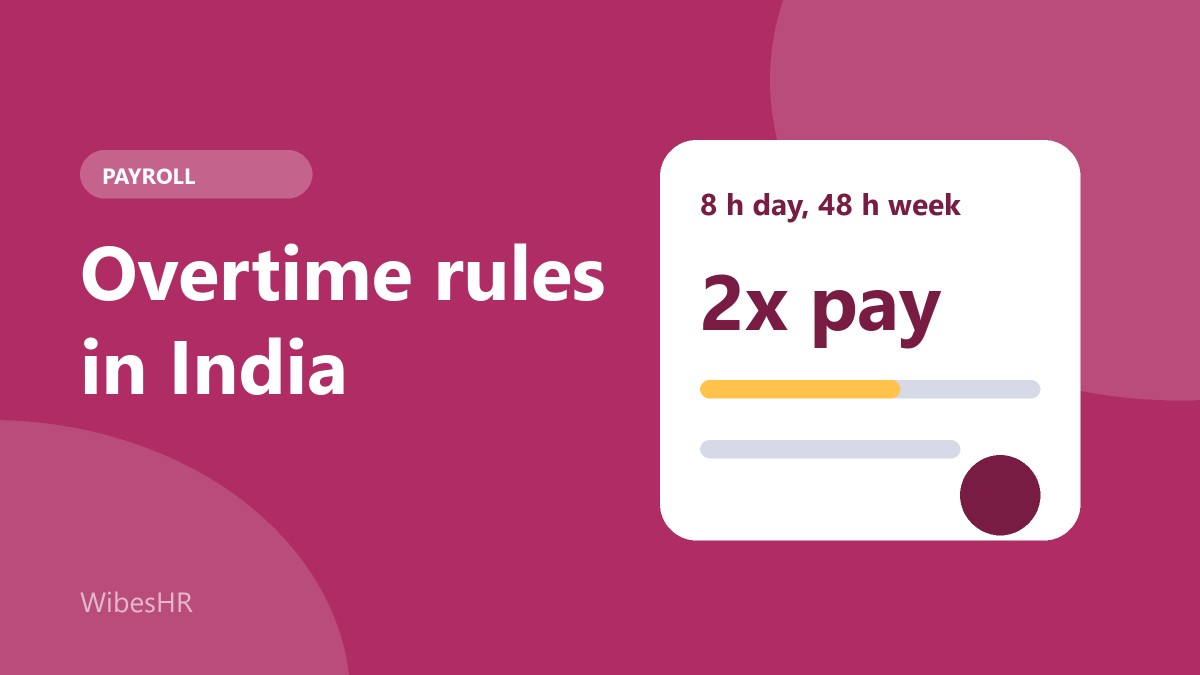
| Normal hours | 8 hours a day and 48 hours a week |
| Overtime rate | Not less than twice the normal rate of wages, for every hour or part of an hour worked beyond the limit |
| When it counts | More than 8 hours in a day, or more than 48 hours in a week. The Ministry's summary says overtime is counted on the daily or weekly basis, whichever favours the worker |
| Consent | A worker can be asked to work overtime only with the worker's consent. This also applies to women |
| When it is paid | At the end of each wage period |
| Flexible day length | Government material describes up to 12 hours a day in a 4-day week, 9.5 hours in a 5-day week and 8 hours in a 6-day week, as long as the week stays within 48 hours |
| Who is covered | The Ministry's FAQ says any employee whose minimum wage is fixed under the Code qualifies, including supervisory and managerial staff. Check how it applies to senior roles in your case |
| Quarterly cap on overtime hours | The codes leave this to the government. Official material we found gives different figures (50, 75, 100 and a maximum of 125 hours a quarter), so check the rules in force for your state or sector |
Under the old Factories Act, overtime was paid at twice the ordinary rate beyond nine hours in a day or 48 hours in a week, and the ordinary rate included basic wages and allowances but not bonus or overtime itself. If your establishment still follows an old Act or a state law, use that rule until the new rules apply to you.
How to calculate overtime pay
Step 1: the ordinary rate for one hour
The law says overtime is paid at not less than twice the normal rate of wages, but it does not give one formula for the hourly rate in the sources we checked. In practice employers fix it in policy, and the usual method is:
- Monthly wages divided by the number of working days (many use 26, others 30 or the actual working days)
- Divided by the hours in a normal day (usually 8)
Decide which pay components go into the monthly wages. Under the Code on Wages, wages means basic pay, dearness allowance and retaining allowance, plus any allowances above 50% of total remuneration. Some state laws and contracts use a wider base. Write it down in your policy and use it for everybody.
Step 2: a worked example
An employee's monthly wages are ₹30,000. Using 26 days and 8 hours:
| Step | Calculation | Amount |
|---|---|---|
| Rate for one normal hour | ₹30,000 / 26 / 8 | ₹144.23 |
| Overtime rate for one hour | 2 x ₹144.23 | ₹288.46 |
| Pay for 10 hours of overtime | 10 x ₹288.46 | ₹2,884.62 |
Step 3: daily or weekly, whichever is higher
A 6-day week with a limit of 8 hours a day and 48 hours a week. Using the same rate of ₹288.46 for an overtime hour:
| Week | Hours worked (Mon to Sat) | Daily basis | Weekly basis | Pay on the higher basis |
|---|---|---|---|---|
| A | 9, 9, 9, 9, 9, 5 = 50 total | 5 hours | 2 hours | 5 x ₹288.46 = ₹1,442.31 |
| B | 10, 8, 8, 8, 8, 8 = 50 total | 2 hours | 2 hours | 2 x ₹288.46 = ₹576.92 |
In week A the weekly total is only 2 hours over 48, but the worker went past 8 hours on five days, so the daily count (5 hours) favours the worker. Part of an hour is also paid, so a worker who stays 25 minutes late is owed those 25 minutes at the overtime rate. Confirm with your adviser whether to pay such minutes proportionately or to round them up, and apply the same method to everyone.
Overtime and PF, ESI and tax
- The 50% rule: the Ministry's FAQ says overtime allowance is counted among the components in the 50% wage test, and if allowances exceed 50% of total remuneration the excess is added back to wages. We explain this in our guide to the new labour codes and payroll
- ESI: ESIC treats overtime as wages for the purpose of charging the contribution only. It is left out when testing the ₹21,000 coverage limit, but the 0.75% and 3.25% contributions are worked out on pay that includes overtime. See our guide to PF and ESI
- Income tax: overtime pay is taxable salary and goes into the employee's TDS and Form 16
- Provident fund: check how overtime is treated for PF wages, because the 50% rule and your pay heads decide what counts as wages
What to put in your overtime policy
- Normal hours for each shift and the weekly limit
- When overtime starts: after the shift hours each day, after the weekly total, or both, with the more favourable basis for the worker
- The rate for a working day, a weekly off and a holiday, and for night work if you pay extra
- How the hourly rate is worked out: the pay components, the number of days and the hours a day
- How minutes are counted: minimum minutes, rounding, and part of an hour
- Limits per day, per month or per quarter, as set by your state or sector rules
- Worker consent: how it is asked for and recorded
- Approval: who approves overtime, what record is kept and how fast it is paid
- Whether time off in place of pay is allowed. Check with your adviser before replacing paid overtime with time off
- Payment: overtime is paid at the end of each wage period, with its own line on the payslip
The mistakes employers make
- Paying a single rate for overtime where the law requires double
- Counting only the daily hours or only the weekly hours, instead of the basis that favours the worker
- Rounding every claim down, so that part-hours are never paid
- No record of the worker's consent and the manager's approval
- Using an hourly rate that is lower than the legal rate of wages for some employees
- Leaving overtime out of the ESI contribution because it is excluded from the coverage test
- Applying one national rule when a state shops and establishments law sets a different limit
- Paying overtime late, or only when the employee asks
How WibesHR handles overtime
The WibesHR HR and payroll module has an overtime module that you switch on when you want it. You set a policy with the multipliers for working days, weekly offs and holidays, and a night rate if you pay one, the rounding and minimum minutes, daily and monthly limits, and how the hourly rate is worked out (a share of monthly pay, divided by a fixed number of days or the working days, and by the hours a day). Overtime can be counted over the day, the week (with the day the week starts on) or the month, and a department or an individual employee can have their own policy.
Attendance is compared with the shift each night, and the extra hours appear as waiting entries that an employee can also request. The manager approves, or approves fewer hours, and only approved hours are paid. The approved amount goes into the pay run as an "Overtime (approved)" earning, and the payslip shows the hours. A report shows overtime cost by department and by person. There is an India template at twice the ordinary rate, which is a starting point from public summaries, not legal advice.
To be clear about the limits: check the template against your own rules before using it. It counts overtime after the shift hours, rounds down to 15 minutes with a 15-minute minimum, and takes the hourly rate as 100% of monthly pay over 26 days, so you may need to change the rounding if you pay part-hours, and the pay share if your rate of wages should be basic pay and dearness allowance only. WibesHR does not record worker consent as a separate step, so keep that record in your own process, and it does not check state shops and establishments limits for you. Plans are priced per employee per month, and the 7-day free trial includes every feature and needs no payment details.
Overtime is paid from attendance, so it helps to know how attendance, leave and payroll connect. Read our guide to leave and attendance management software.
Frequently asked questions
What is the overtime rate in India?
Not less than twice the normal rate of wages for every hour or part of an hour worked beyond the limit. State shops and establishments laws can set their own rates, so check yours.
How many hours is normal work in India?
8 hours a day and 48 hours a week under the OSH Code. Government material also describes longer days (up to 12 hours in a 4-day week, 9.5 hours in a 5-day week) as long as the week stays within 48 hours.
Can an employer force overtime?
No. Overtime needs the worker's consent, including for women, and it must be paid at the overtime rate at the end of each wage period.
Is overtime included in ESI?
Overtime is left out when testing the ₹21,000 coverage limit, but it is included in the wages on which the ESI contribution is calculated.
Is there a limit on overtime hours?
The codes leave the limit on overtime hours (for example per quarter) to the government. The figures in official material differ, so check the rules in force for your state or sector.
Is this legal advice?
No. The rules under the labour codes are still being finalised and states have their own laws. Use this guide to understand the process and check the details with the Ministry of Labour and Employment, your state rules and your adviser.